Wednesday, October 27, 2010

Web Design for ROI


To increase sales, either you increase conversions, or increase contacts per day. This book outlines how to design websites for increased conversions. Web design for ROI presents a method of thinking [usability and audience focused] which managers should pursue in order to build and optimize websites for increased return on investment.

The online commerce world is comparable to the old school brick and mortar retailing industry, where stores assumed if the product had demand , the buyer would purchase. Retailers then learned that placement and external variables can affect consumer spending. Similarly, web design is broken [average cart abandonment rate is 59.8%] and needs to be redesigned for increased ROI.

According to web design for ROI, the top design efforts should focus on forms & checkout, landing pages, category pages, and detail pages. This design focus is contrary to much of the current development efforts seen by large corporations where the homepage is the focus.

Taking a new design approach will ensure your website stands out and converts traffic using the desired call to action, [thus increasing ROI].

The in class power point will outline why each section of design is important to creating a website built for ROI.

Book Authors:
Lance Loveday and Sandra Niehaus


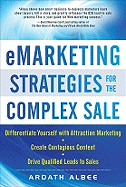
Book Review: eMarketing Strategies
for the Complex Sale

(by Ardath Albee)
Post by: Eric Kneifel

I decided to hop onto Amazon as soon as I found out we had to review a book related to ecommerce. The reviews I read online seemed to hold this book in high regard, and I figured I could learn a lot from it. My hope was that this book would help me pursue different avenues of emarketing and follow through better with sales for my website (www.localcertificates.com). I also hoped that through this book I could gain insight as to how I could better hold customers’ attention on the website and better engage them with the company.

As I began reading through the book however, I realized it is designed to deal with a very different sales structure than I deal with in my company. The key term in the title rests in the 'complex sale'. The sales process described throughout the book includes multiple steps and multiple customer interactions for one sale. I would certainly recommend this book to anyone dealing specifically in this area of sales, but there were only a handful of good takeaways for a company with a simpler sales model.

I actually think the book was so focused on the process of the complex sale that it didn't seem to offer very unique information about eMarketing strategies; much of the concepts discussed in this regard is right in line with information someone could find through a Google search. Plus, many of the concepts discussed weren't necessarily tied into emarketing as much as they were to marketing in general. Natural nurturing, creating contagious content, and following a persistent progression (sections of the book), all relate to the sales process and how to engage the customer more with the company.

Format:
There are six sections in this book, and it seems to follow the 'complex' sales process, so as the reader gets further through the book, they’re reading about issues that arise further down the sales process pipeline.

(1) eMarketing Essentials
(2) Customer Consensus
(3) Natural Nurturing
(4) Contagious Content
(5) Persistent Progression
(6) Meaningful Metrics


Key Takeaways:
Here are some of the key takeaways almost anyone could get from the book and put into practice immediately.

-We need to understand our customers’ persona, not just what they’ve bought.

-We can speed up the sales progression if we align our insights of a customer to influence them.

-Creating contagious content is important to keep bringing customers back, and to encourage them to spread the wordIt is VERY important to track sales progress and determine best-practice strategies

-Stories can help customers remember your service or product better.


Links:
YouTube Video summary of Ch 13
Amazon Reviews
Ardath Albee's YouTube Videos

Tuesday, October 26, 2010

Book Review of The New Rules of Marketing & PR


After going through all the stages of grief and finally resting on acceptance, I came to terms that I needed to find an outside book for our book review. I did not know where to begin and started to explore all my options. I decided to go to Barnes and Noble to see what books where available. I went to the e-marketing section and found the bestseller The New Rules of Marketing and PR written by David Meerman Scott. After reading the summary about the new dynamics of e-marketing and how many businesses are falling behind, I decided this was the book I wanted to read.

The theme of the book was about how the strategic concept of marketing has changed due to the advent of e-marketing and its effects. No longer can business continue their big one-way communication marketing campaigns. Today, more consumers go online to research the products and services they intend to purchase and do not want to be attacked by product spin offs or untrustworthy one-way messages. DM Scott emphasizes that without understanding your customers and engaging them, a business is failing to develop their customer-base. Technological advances in digital communications have allowed small businesses to compete with larger scaled businesses and put up a successful fight. It is imperative for marketers to understand these changes and how to properly implement new social media services and programs to effectively engage their customer-base.

Great Take-Away from the book: No one cares about your product. What they care about is their problem and the solution you have to offer. Therefore, marketers need to understand their customer-base and communicate with them. E-Marketing has enabled businesses to do just this. Businesses that do not seize the opportunity to engage their customer-base will be left behind.

Great Example: David M Scott gives the e-marketing example of The Million Dollar Coupon in his book. This marketing campaign was developed by a man that wanted to sell his mansion and needed to drive as many viewers to his web site to advertise his property. Instead of doling out a large amount of funding for a traditional advertisement campaign, the seller set up a web site with a printable coupon for one million dollars off the house. He also utilized the catchy domain www.themilliondollarcoupon.com to advertise his property. What the seller did on his own replaced the need of an expensive realtor or advertisement agency.

Overall this book was well-written and simple to follow. Readers could pick any chapter in the book, dive in and begin reading and understanding. Essentially the book offers one large theme: marketing has changed and we need to stop looking at it like we once did. David Meerman Scott does an excellent job of defining how the rules have changed and what aspects of e-marketing businesses can use to reach their customers.

Links:

User Reviews of The New Rules of Marketing and PR

User Reviews from Amazon

DM Scott's Website

http://www.davidmeermanscott.com/

DM Scott's Blog

http://www.webinknow.com/

DM Scott's Bio

http://www.davidmeermanscott.com/bio.htm

The Million Dollar Coupon

http://www.milliondollarcoupon.com

DM Scott’s Vimeo Page

http://vimeo.com/dmscott


Click here to buy this book

I reviewed "Twitter Power, 2.0: How to Dominate Your Market One Tweet at a Time" by Joel Comm.

Since I never looked at Twitter and certainly don't understand the craze behind it, I thought this would be a great book to read. Surprisingly, I learned alot and had fun setting up my Twitter account following Mr. Comm's step by step guide. You should follow me on twitter @ryan_twilliams. (I don't have many Tweets and not sure how long I'll keep it up-I can barely keep up on my Facebook account).

The book is great for anyone starting out. It probably would be too basic for someone who has spent more than a few hours playing with Twitter. But for newbies like me, I would highly recommend the book.

Mr. Comm is a master of explaining everything there is to know about Twitter. After explaining social media in general, he briefly discuses why Twitter is so powerful. He then walks the reader through setting up an account and getting started the right way. Mr. Comm even gives you secrets how to liven up your profile page and gives you a 10% discount code for a company who custom makes backgrounds. Once you are up and running on Twitter Mr. Comm walks you through how to build a following and whether more is better. His advice on building a following is very important for companies so they do not come off as creepy or unwelcome.

What is most useful about his book is his advice about how to connect with customers and how to leverage Twitter to build your brand and to drive followers to your site to a) buy stuff or b) read your blog and click on advertisers.

Rounding out his book is a 30 day action plan for dominating Twitter. If I was getting started and wanted to build my brand or build a loyal group of followers his plan would easily get me there.

I now understand why successful companies are using Twitter to their advantage. I played around quite a bit looking at different companies and how they used Twitter. Some were all advertisements (go to our site and buy X, Y, and Z), and some were pure customer service driven. However, Gatorade (@Gatorade) and Toyota (@Toyota) do a great job of mixing the types of Tweets, using Keyword Search to find what people are saying about their brand/products, and addressing their customers needs.

I still don't understand how Ashton Kutcher has nearly 6 million followers.

Great video on Twitter: http://www.youtube.com/watch?v=KHAZt-Exuaw

Book Review of Socialnomics by Erik Qualman


I just finished reading Socialnomics, by Erik Qualman, and enjoyed it. I think that you will too. Qualman is an MBA Professor at the Hult International Business School and Global Vice President of Digital Marketing for EF Education, but is probably better known for his hyper-paced viral video, The Social Media Revolution on YouTube.


The book is simple and direct with three key themes.


Theme #1: Social Media will provide for a “newer and brighter world for consumers and businesses”. This will occur because communities of people who are interested in a particular product and service can easily come together through social media. Business can then just as easily find these communities that are interested in their product and service and engage in a meaningful dialog with them that will improve the customer experience, the product, and ultimately the bottom line.


Theme #2: Social Media will make it impossible for people and, on a grander scale, businesses to engage in “social schizophrenia”. The speed and transparency of information across social networks means you can’t be a party animal on Saturday night and a choirboy on Sunday. If you’re a corporation, you can’t spout “green” and dump toxic waste. Someone will notice and comment.


Theme #3: Social Media will change the face of search. There is a reason Google is so interested in Facebook. Wouldn’t you rather get a product or service recommendation from your network than from someone you don’t know?


At about 240 pages, the book reads quickly and is organized in such a way that it is easy to put down and pick back up when you have a spare moment or two. If you’re interested in where business marketing is going in the next several years, pick this up along with a copy of The New Rules of Marketing and PR by David Meerman Scott.

Go here to see my video review of Socialnomics.

"Social Media Marketing: An Hour a Day" by Dave Evans reviewed by Rob "CHiLLy" Williamson

For my e-Commerce book, I selected “Social Media Marketing: An Hour A Day” by Dave Evans. My primary reason for selection is that social media is really just coming of age in defining how a generation communicates, especially with the emergence of mobile apps. I feel that a profound understanding of the subject will be a vital key to success for small business, entrepreneurial-type CEOs. Specifically, I hoped to gain a working knowledge of specific tools and websites available.

Thus far, the book has not disappointed. This book is about how to properly use and manage the various tactics available via Social Media when developing a fully integrated marketing plan. It was written as a practical self-study guide that current marketers can use to master the fundamental paradox they now face: “giving up control” while “simultaneously gaining influence.”

This book seeks to expand on “a world without interruption” and “where the information needed to make an informed choice [is] readily available.” The author's goal is to provide accurate insight and experience as to how social media interacts within the classic ‘Purchase Funnel’ at the point of ‘Consideration’. Ultimately, the author attempts to answer his own philosophical question:


"If I couldn’t interrupt you, how would I reach you?”

Dave Evans is a social media guru who earned his reputation through marketing success in numerous capacities. In 1994, he founded Digital Voodoo, a “social media strategy and intelligence firm with expertise in marketing, advertising, and operations” that consults with companies to position their “brand, product, or service for success on the Social Web.” He has also has developed integrated communication strategies for clients such as: Microsoft, Hewlett-Packard, Southwest Airlines, AARP, the US Air Force, AT&T, Wal-Mart, Dial, the PGA, and Chili’s.

This book is designed for “marketers wanting to combine social media skills and expertise with their existing, established capabilities.” His basic assumption is that you’re a current marketer and already have an established marketing plan. Thus, the sheer amount of content can be a little overwhelming for MBA student with virtually no marketing experience. The format is essentially broken into four Parts with each part designed to take a month to complete:

• Part I: Foundation of Social Media
• Part II: Month 1: Prepare for Social Marketing
• Part III: Month 2: Social Media Channels
• Part IV: Month 3: Complete Your Plan

Months 1-3 are set up to complete one (1) hour of exercise each day during a five-day workweek, every week…for 3 months. It is also important to note that this is the approximate time of each ‘online exercise’ and DOES NOT include time to actually read [and fully digest] the book (393 pages of detailed and technical content). Most of the concepts covered depend on completing at least some of previous exercises so as to have a ‘working knowledge’ going forward, thus making it difficult to jump to various topics. However, the author claims you can start at any point you like given your level of experience..which is likely true, however it didn't apply to me.

- see my Review on Amazon.com (with the author's reply)

Someone completing the book in its entirety will undoubtedly be “rewarded with a plethora of online and social media tools at their disposal.” In contrast to current marketing efforts focused on traditional media that ‘interrupt’ the consumer in a one-way targeted messages directed by the marketer, this book does a fantastic job of emphasizing the growing role of Social Media in all aspects of business related communications. Particularly, it demonstrates how “the voice of the individual is again asserting its fundamental value, this time expressed through its role in building the collective conversation as it now occurs online."

This book is an excellent ‘how to’ guide for successfully developing and implementing an integrated Social Media marketing plan. “This book is about learning how to properly use the Social Web to your business advantage” and “effectively participate as a marketer” in the Web 2.0 era. While each chapter provides specific insight at particular phases of the social media marketing process, the following are the chapters I found most informative and useful:

Chapter 4: Week 1: Web 2.0: The Social Web
-- Discussion on the various Social Laws (Sarnoff, Metcalfe, Reed) and how Social Media derives its value from the individual and the collective, not the mass.
-- Great resource for finding and using ‘social’ tools for the first time. Detailed lessons on how to appropriately access and use: Social Media Content, Blogs & Wikis, Multimedia, Microblogs & Tagging, RSS, and Social Networks, with the advantages/disadvantages of each.

Chapter 7: Week 4: Influence and Measurement
-- Discussion on why the “Measurement of Influence” is critical to successful implementation and why “Influence-rather than control-is the central element at disposal in Social Web.”
-- Excellent lessons on: How do you ‘quantify’ a conversation and correctly apply Social Media influence.
-- Paves a foundation for tracking ‘influence’ and how essential those metrics are in determining ROI. Emphasizes the time it takes to gather appropriate quantitative metrics.

Chapter 13: Week 1: Objectives, Metrics, and ROI
-- Discussion on why it is crucial to identify and clearly state objectives before deciding on elements/channels of Social Media. Essential to determine ‘what’ and ‘where’ to measure
 Content: the social conversations and artifacts themselves
 Relevance: the degree to which what being said matters
 Impact: the bottom line—a net benefit (or loss) as a direct measure of change in desired outcomes following exposure
-- Exceptional lessons on how the behavior of target audience is key to setting strategy and identifying metrics used in supporting and measuring success of campaign. Emphasis is on metrics collected near/within the purchase process link conversations to actual impact on conversions. This data helps establish ROI for social media program.


Conclusion: A brilliant book based on the subject matter alone...the content and level of instruction are absolutely fascinating! However, I quickly became disheartened when I realized I would not be able to fully complete the book in the time allotted. As a guidepost for the full-timer marketer, I highly recommend this book. As a full-time MBA student taking two classes and working full-time, just trying to find “an hour a day” is practically impossible and, thus, tempers my recommendation quite a bit. If this book were to be used by an MBA class, I would definitely recommend it as a primary-source textbook for use in a Social Media specific class.

BTW, Dave (the author) definitely gets the topics he discusses. He's very active in responding to comments on his book via Amazon as well as tweets (@evansdave). You can see his responses to me @pilotchilly!


LINKS:

**My FULL REVIEW of the book along with my OUTLINE of each of the chapters**

**My in-class powerpoint PRESENTATION and YouTube VIDEO**

Facebook: Social Media Marketing: An Hour a Day

Readthis.com: Dave's website dedicated to his book--Chapter summaries as well as links to other books and resources

Dave Evans: Overview of Social Media:

  1. Lesson 1: Beyond marketing, how is Social Media related to business?
  2. Lesson 2: Is there a good starting point for connecting customers with a brand, product, or service?
  3. Lesson 3: Social Media is built on passions, causes, and lifestyles.
  4. Lesson 4: What is the social graph and how can marketer's leverage it.
  5. Lesson 5: People say that Social Media marketing is not measureable.

Similar Books to consider either in-conjunction-with or in-lieu-of this book:

by the same author:

recommended by the author:

'An Hour A Day' Series produced by Sybex:

Alternatives:

Friday, October 22, 2010

"The Mesh" as Reviewed by Ethan Beute

For this book review project, I wanted to use David Meerman Scott’s “The New Rules of Marketing and PR,” but it was claimed first by another student. I wanted to use “Inbound Marketing” by Brian Halligan and Dharmesh Shah, the guys at Hubspot, but it was also taken. I moved on to “Rework” by Jason Fried and David Heinemeier Hansson, the guys at 37signals, but it proved to be more general business than specific ecommerce. I did write that one up anyway - you can my glowing review of "Rework" right here.

So, I was at a loss … until I read a blog post from Seth Godin propping up a new, “big idea” book (in which he’s name checked as the pioneer of “permission marketing”).

Lisa Gansky’s “The Mesh: Why The Future Of Business Is Sharing” is absolutely both “brand new” and “big idea.” It’s also “right now.” The Mesh is a book that could not have been written 5 years ago, though much of the concept’s foundation was well underway at that time. Likewise, it’s a book at which we could look back 5 years from now and appreciate how insightful and telling her vision was at the time.

Aside from having to read about businesses, strategies and tactics as being “meshy” or “very meshy,” I found the book a complete pleasure to read. Aside from having to accept a few arguments and ideas without direct connection to the presumably-backing references listed at the end (no direct citations), I found Gansky’s vision smart, compelling and forward looking.

So what is “The Mesh?” In short, think Netflix versus Blockbuster. Though both are based on the concept of buy once and sell many times (renting out the same DVD over and over again to different customers), Netflix is an information company. Layers upon layers of data are collected and processed to make it easier and easier for Netflix customers to find, watch and review movies and TV shows. Meanwhile, Blockbuster’s in bankruptcy protection.

Gansky’s preferred example is Zipcar, an information company that happens to share cars (as opposed to making and/or selling cars). It's exemplary because it touches on all the main characteristics of Mesh companies:
  • Core offering that's shared
  • Reliance on web, mobile and social networks
  • Frequent interactions with each customer
  • Layers and layers of data collected about each car, customer, transaction, trip, etc.
  • Data analysis to produce offers that are more and more personal, timely and relevant
  • Partnerships with other companies to provide more value and collect more data
Once you sign up for Zipcar, you're given a Zipcard. You can use a web or mobile app to find cars near you and reserve one for an hour, an afternoon, a couple days or more. Your Zipcard or mobile phone unlocks the car you've reserved; the keys are waiting inside. The cars are typically fun models and each is given a name. For those who either are on vacation or live in large cities, this kind of easy access to high quality cars exactly when and where you need them is more convenient and less expensive than owning the same car outright.

Other companies highlighted include Prosper (peer-to-peer lending), thredUp (clothes), Crushpad (wine making), Kickstarter (project funding), Roomorama (apartments), several other car-sharing services and many more. Again, Zipcar and Netflix seem to exemplify best her full vision.

Included in this fast, fun read:

  • Characteristics of Mesh companies
  • Load of example, plus a half dozen or so "Case Study" breakouts
  • Macro-level enabling factors and driving forces
  • Specific advantages of employing Mesh strategies
  • How and why Mesh strategies threaten traditional models
  • Points to consider for your own Mesh start-up

I highly recommend “The Mesh” for marketers, entrepreneurs, environmentalists and anyone else who’s into what’s happening right now and what’s around the corner.

LINKS

The Mesh Homepage and Business Directory:

My Video Review of The Mesh:

My Non-Book-Review Blog Post on The Mesh:

Article in The Economist:

Article at Treehugger.com:

Zipcar Videos:

Additional Videos: